


The Project Manager Mindset
Are your people delivering important work without the tools to handle the pressure?
Most organisations train people on process… But when work gets busy, unclear or high stakes, project delivery comes down to how people think, communicate and make decisions.
The Project Manager Mindset builds those skills, so work moves forward with more clarity, less friction and far more confidence.
In Person Training from £1750
Online Access from £295 per license
When important projects land on capable people, but nobody has really taught them how to handle the pressure…
Most organisations do not have a shortage of effort. They have good people trying to keep project work moving while also doing the job they were hired to do.
That is where things start to slip.
Projects drift because conversations happen too late. Priorities change, but expectations do not. Decisions get made in a rush, or not made at all. People hold concerns back because they do not want to create friction.
From the outside, projects still looks busy. Underneath, it becomes harder to trust.
Leaders can feel this. Progress depends too much on individual judgement, confidence and goodwill rather than a consistent way of working.
That is a real business problem. PMI found that organisations which take power skills seriously perform better where it counts: more projects meet business goals, less scope creeps, and less budget is lost when work fails. Those skills are not abstract. They are communication, problem-solving, collaborative leadership and strategic thinking.
The wider picture points the same way. In the UK, 964,000 workers reported work-related stress, depression or anxiety in 2024/25, with 22.1 million working days lost. Half of employees with poorer-quality managers say work harms their mental health. And 82% of new managers step into leadership without formal training. When people are asked to lead work without the skills to handle pressure, speak clearly and make steady decisions, the cost shows up in performance as well as wellbeing.
Without those skills, even strong teams struggle to deliver consistently.
Why delivery still slips
Most delivery issues are not caused by a lack of process
They show up in how people think, communicate and make decisions when the pressure builds.
When work starts to feel messy, most organisations add more structure. That helps, but it does not change what happens in the moments that actually shape delivery.
A concern is seen, but not raised
Something feels off, but it gets left. Small issues build in the background and become harder to deal with later.
A decision is made to keep things moving
Progress wins over clarity. It solves the immediate pressure, but often creates more work further down the line.
Priorities shift, but alignment does not
Direction changes, but not everyone moves with it. Work keeps happening, just not always in the same direction.
A conversation is avoided
People stay polite to avoid tension, but the lack of clarity slows things down and makes trust harder to build.
Organisations that focus on communication, problem-solving and leadership deliver more consistently. More projects meet their goals, less scope drifts, and less budget is lost.
Introducing The Project Manager Mindset
A practical programme built around the power skills that shape Project Delivery every day
The Project Manager Mindset is built for people who are trusted to move important work forward, even if project delivery is not their formal job.
It focuses on the power skills that sit underneath good delivery: self-awareness, communication, judgement, problem-solving, collaboration and the ability to create progress when things feel busy or unclear.
These skills matter because projects rarely becomes difficult on paper first. It becomes difficult in people. In how someone responds when the pressure rises. In how clearly they speak when something feels awkward. In how well they can steady the project when priorities shift, confidence drops or everything starts to feel urgent.
That is why the programme is split into three parts.
Each one deals with a different part of how delivery actually happens.
SELF
How you show up when the pressure is on
Before someone can lead work well, they need to understand how they lead themselves.
This part looks at what happens in you when workload rises, expectations are unclear or something important feels at risk. It covers self-awareness, stress response, cognitive load, judgement, assumptions and the habits that shape how you react under pressure.
Because the truth is simple enough: if someone cannot spot what is happening in themselves, it becomes much harder to respond well around other people.
Self gives people better awareness of their own patterns, stronger control over how they respond, and a clearer way to think when things feel noisy.
RELATIONSHIPS
How you work with people when something needs to move
Delivery moves through conversations.
It depends on whether people can raise concerns early, set expectations clearly, challenge without creating fallout, and keep trust intact when the work gets difficult.
This part focuses on the human side of progress: communication, emotional intelligence, psychological safety, conflict, boundaries and influence.
Because many delivery issues do not begin as delivery issues. They begin as conversations that were softened, delayed or never properly had.
Relationships helps people communicate with more clarity, handle tension with more confidence and work through other people rather than around them.
PRODUCTIVITY
How you create progress when everything feels urgent
Even capable people can lose their footing when work becomes crowded, reactive and full of moving parts.
This part focuses on the practical skills that help people turn pressure into progress. Prioritising properly. Breaking work into manageable steps. Judging what matters now versus what can wait. Keeping momentum when the picture is incomplete. Making decisions without overcommitting.
This is where the mindset becomes visible in the work itself.
Productivity gives people a steadier way to move things forward, without defaulting to busyness, guesswork or unnecessary noise.
Together, these three areas give people a more complete way to handle project-shaped work, not just the tasks inside it.
Powered by DLS
The Project Manager Mindset is built on the Delivery Leadership System (DLS).
The same thinking we use to support live delivery, applied to how people lead projects day to day.
At the core of this system are three pillars:
Clarity. Traction. Transformation.
How DLS Applies to the Project Lifecycle
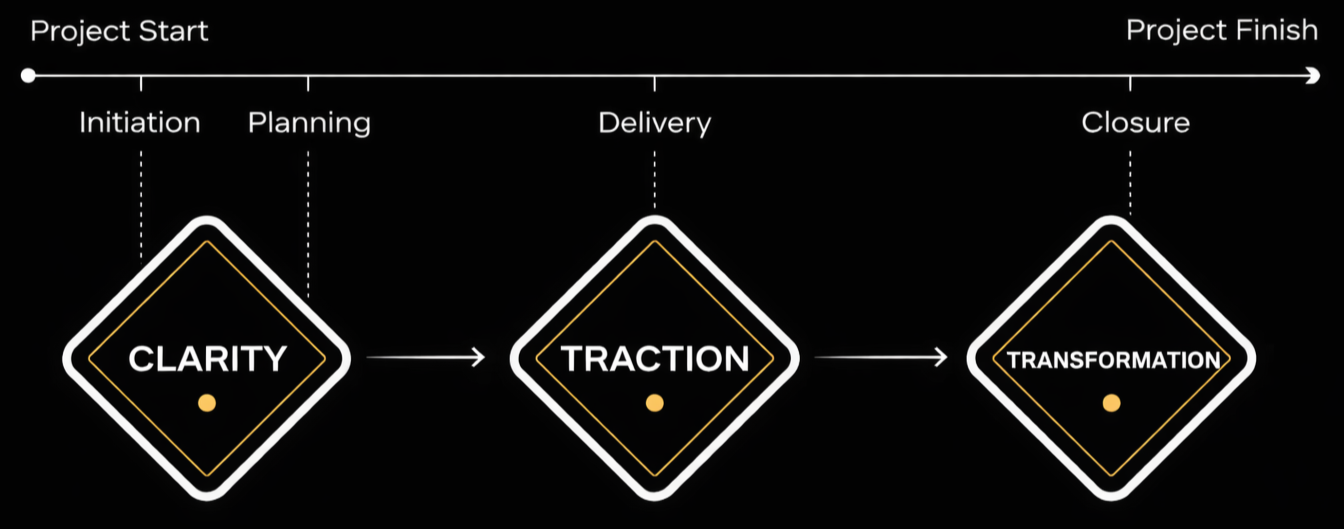
Clarity
Build the project on solid foundations
We take time to understand the environment before driving the work.
What has been sold, what success looks like, and where pressure is likely to appear.
Because when that is unclear, everything that follows becomes harder to control.
The Outcomes:
Better decisions from the start
Fewer surprises as delivery unfolds
Stronger alignment across stakeholders
Guided by well established thinking in psychology, behavioural science and leadership research.
Traction
Getting shit done!
Once the project is understood, the job is simple.
Get things done.
We focus on the decisions that need to be made, the risks that need to be dealt with, and the work that actually moves the project forward.
Because doing more does not move a project forward.
Focusing on the right things does.
The Outcomes:
Decisions made when they need to be
Issues dealt with before they grow
Progress that is visible week to week
Shaped by practical thinking in execution, communication and leadership.
Transformation
Leave the delivery environment better than you found it
Delivery does not just produce outcomes.
It exposes how the organisation actually works.
How decisions are made.
Where things slow down.
How teams interact under pressure.
We use that to strengthen the environment while the work is happening, not after it finishes.
The Outcomes:
Stronger ways of working across teams
Clearer ownership and decision making
Better delivery on the next project, not just this one
Informed by thinking in leadership, organisational design and modern management practice.
How Project Leadership as a Service works?
Step 1 - Rapid understanding
Apply Clarity
We start by understanding the environment before doing anything else.
How you currently deliver projects
What has been sold and what the customer expects
Who is involved and how decisions are made
Where pressure is already building
We separate what is known from what is assumed and deal with that early.
Step 2 - Align and take control
Apply Traction
Once the situation is clear, we bring structure to how the project runs.
Make decisions visible
Set clear priorities
Establish a working rhythm for delivery
We focus attention on the work that actually moves the project forward.
Step 3 - Lead delivery
Apply Traction and Transformation
We stay close to delivery as it unfolds.
Keep progress moving week to week
Surface risks early
Keep stakeholders aligned
At the same time, we improve how the project operates.
Clarify ownership
Remove blockers
Strengthen how decisions are made
Pricing
Project leaders are provided on a fractional basis, depending on what your delivery environment requires.
Support typically ranges from one to five days per week, whether that’s for a single project or across multiple workstreams. Engagements can be short-term to stabilise delivery, or ongoing where consistent leadership is needed.
From £800 per day
Delivery doesn’t wait. Neither do we.
When you need support, we aim to step in within days
Questions about Project Leadership as a Service?
Not sure if this is the right fit, or want to understand how it would work in your environment? We’re happy to talk it through.
Think this might be what you need?
If delivery pressure has increased, we can have a quick conversation about what is going on and whether Project Leadership as a Service makes sense for you.
Proven in Real Delivery Environments





Hello,
My name is Kristian, and I am the founder of Coordinated Solutions.
I’ve spent most of my career delivering projects, but I learned far more about delivery after starting a business than I ever did inside the role itself. Once you are responsible for winning work, keeping customers, protecting margin, and making decisions under pressure, you see projects differently.
You realise quickly that delivery is not held together by process alone.
It is shaped by judgement, communication, and how people behave when things feel uncertain. Most delivery problems are not really about plans or tools. They come from unclear ownership, missed signals, and decisions arriving too late.
That changed how I think about project leadership.
It also raised a bigger question…
If strong delivery depends on how people think and operate under pressure, how do you make that consistent?
That is why we built Project Leadership as a Service underpinned by The Delivery Leadership System.
Not to add more process, but to bring a more complete way of leading projects into environments where it actually matters. One that understands the work, the people around it, and the pressure that comes with it.
Because when that is right, projects move. Decisions get made. And customers feel the difference.
Kristian Harris, Founder of Coordinated Solutions
Still have Questions?
-
We usually step into projects in days, not weeks.
The priority is getting up to speed quickly and taking control of the delivery environment early. -
No.
We can work alongside your team or step in where there is a gap. The focus is on strengthening delivery, not disrupting it. -
Most of our work sits in technology and change delivery.
Infrastructure, cloud, migrations, and complex customer-facing projects where coordination and leadership really matter. -
A contractor gives you capacity.
We bring a consistent way of leading projects, including how decisions are made, how risks are handled, and how communication is managed under pressure. -
We work with whatever structure you already use.
Our focus is on how the project is led day to day, not forcing a new process onto your environment. -
We focus on understanding three things early.
How you operate, what has been sold, and what the customer expects. That gives us enough context to start making useful decisions quickly. -
We represent your organisation directly.
Communication is clear, calm, and focused on decisions and progress, not just updates. -
That is usually when we are brought in.
We focus on understanding what is really happening, stabilising the environment, and getting delivery moving again. -
It depends on the project.
Some need consistent weekly leadership, others need more focused support. Most clients already have a sense of what they need. -
We do not just step away.
We make sure the environment is left in a better place, with clearer ways of working and stronger delivery going forward.